The platform

How Locumfy turns resumes into a working marketplace.

Underneath the app and the portal sits an engine that reads unstructured resumes, structures what it finds, verifies it against official records, and uses the result to match people to roles and to each other. This is what makes a healthcare network different from a general one.

Resume parsing

Eighteen structured sections out of one document.

A resume arrives as a PDF or a Word file — prose, tables, inconsistent headings and all. The parsing engine extracts the text, identifies its structure, and writes the content into discrete, searchable records.

  • Awards
  • Certifications
  • Education
  • Employment
  • Internships
  • Languages
  • Memberships
  • Presentations
  • Publications
  • References
  • Research
  • Residencies
  • Skills
  • Specialties
  • State preferences
  • State licenses
  • Titles
  • Volunteer

Because each section is stored as data rather than text, a facility can filter on an exact certification, a specific residency, or a state licence — and the platform can match a professional to a role on the same detail.

What the engine handles

  • Mixed formats — PDF and Word documents, including scanned layouts and multi-column designs.
  • Inconsistent headings — the same section written a dozen different ways still lands in the right bucket.
  • Dates and durations — employment and education periods normalised so experience can be calculated.
  • Identifiers — licence and registration numbers pulled out and handed to the verification stage.
Credential verification

Cross-checked against official healthcare records.

A parsed profile is matched against the national provider registry using a set of identity heuristics. Once a match is established, the associated public record is linked to the professional and carried through the platform.

Provider registry

National provider identification matched and linked to the profile.

State licences

Licences held by state, with issuing detail and expiry carried on the record.

Registrations

Prescribing and programme registration numbers associated with the verified identity.

Practice detail

Registered practice locations and other verifiable public record attached to the profile.

Why it matters. A facility looking at a Locumfy profile is not taking a candidate's word for a licence. The verification state travels with the credential — through search results, through an application, and onto the standardized resume.

Standardized resumes

One click from a profile to a facility-ready document.

Reformatting a resume for every submission — and stripping out the personal details a third-party submission is not allowed to carry — is the manual task that consumes recruiting time. Locumfy generates the document instead.

  • Consistent format — every candidate presented in the same structure, built from the same underlying data.
  • Anonymized on demand — name, contact details and employer names removed for third-party submission, with the clinical substance intact.
  • Compiled for the recipient — the requesting organisation is shown on the document, so it is clear who prepared it.
  • Generated live — the resume is produced from the current profile, so it never goes stale.
app.locumfy.com/candidates
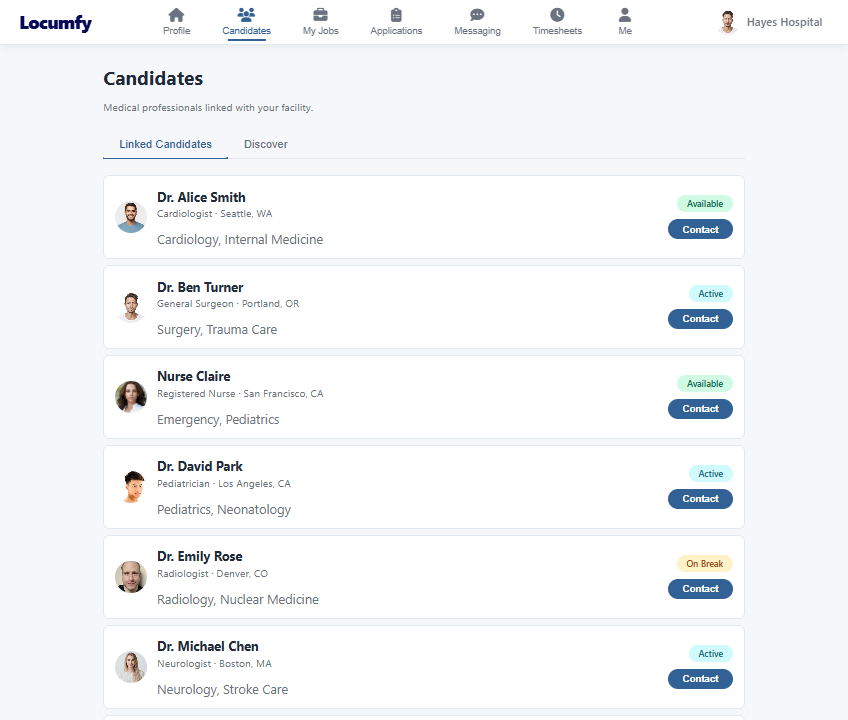
The Candidates page in the facility portal, where a standardized resume can be downloaded for any professional.
Standardized resumes are generated from the candidate list
The connection graph

Suggestions built on real professional overlap.

Structured profiles make it possible to reason about who is likely to know whom. Shared employers, overlapping dates, the same school, the same specialty and the same geography all contribute to a match score, and the strongest candidates surface in the Grow tab.

Shared history

Two clinicians who worked the same unit in the same years are far more likely to know each other than two who simply share a title.

Training overlap

Schools, residencies and internships place people together at a point in time — a strong signal the graph uses.

Specialty and region

Within a discipline and a geography the professional community is small, and the suggestions reflect that.

Workflows

Clear rules that keep both sides in control.

Applications and timesheets each move through an explicit set of states. Nothing is implied, and both parties always know where a piece of work stands.

The job application

StateWhat it means
AppliedThe professional has applied and the facility can see the application.
WithdrawnThe professional pulled out before acceptance. The application closes and becomes read-only.
AcceptedThe facility accepted. Every other open application for that professional is set aside so nobody is double-booked.
DeclinedThe facility passed on the application.
CompleteThe facility closed the assignment. Approved hours stand as the record of the work.

The timesheet

StateWhat it means
OpenThe professional is recording hours against an active assignment.
SubmittedThe professional has signed off the week and sent it to the facility.
ApprovedThe facility that posted the role has reviewed and approved the hours.
RejectedThe facility sent it back; the professional can correct and resubmit.
PaidThe approved hours have been settled and the record closed.

Only the right party can act. A timesheet can only be created against an assignment a professional has actually been accepted for, and only the facility that posted the role can approve it. The rules are enforced by the platform, not by convention.

Architecture

One interface behind three applications.

The mobile app, the web experience and the facility portal all talk to the same versioned interface, which sits on a shared service and data layer. That is why feature parity across screens is structural rather than something that has to be maintained by hand.

ConcernApproach
InterfaceA single versioned REST interface, documented with an OpenAPI specification.
AuthenticationSigned tokens issued by the platform, with distinct professional and facility roles.
Application layerFeature-sliced services with a shared validation engine, on a modern cross-platform runtime.
DataA code-first relational model covering profiles, credentials, jobs, applications, messaging and timesheets.
Web applicationsSingle-page applications for professionals, facilities and operations.
Mobile applicationA cross-platform native app for professionals, sharing the same interface as the web.
DocumentsServer-side document rendering for standardized and anonymized resumes.
StorageEncrypted cloud object storage for uploaded documents.
Language modelsA configurable model provider — hosted or run locally — used for profile summaries and assisted structuring.
ObservabilityStructured logging across the interface and service layers.

Parity by construction

The app and the web are built against the same contract, so a feature exists on both or on neither.

Role-aware by default

Professional and facility permissions are enforced at the interface, not assembled in each client.

Measured end to end

Every state change is recorded, which is what makes the operations dashboard possible without manual reporting.

Operations

The whole marketplace, measured.

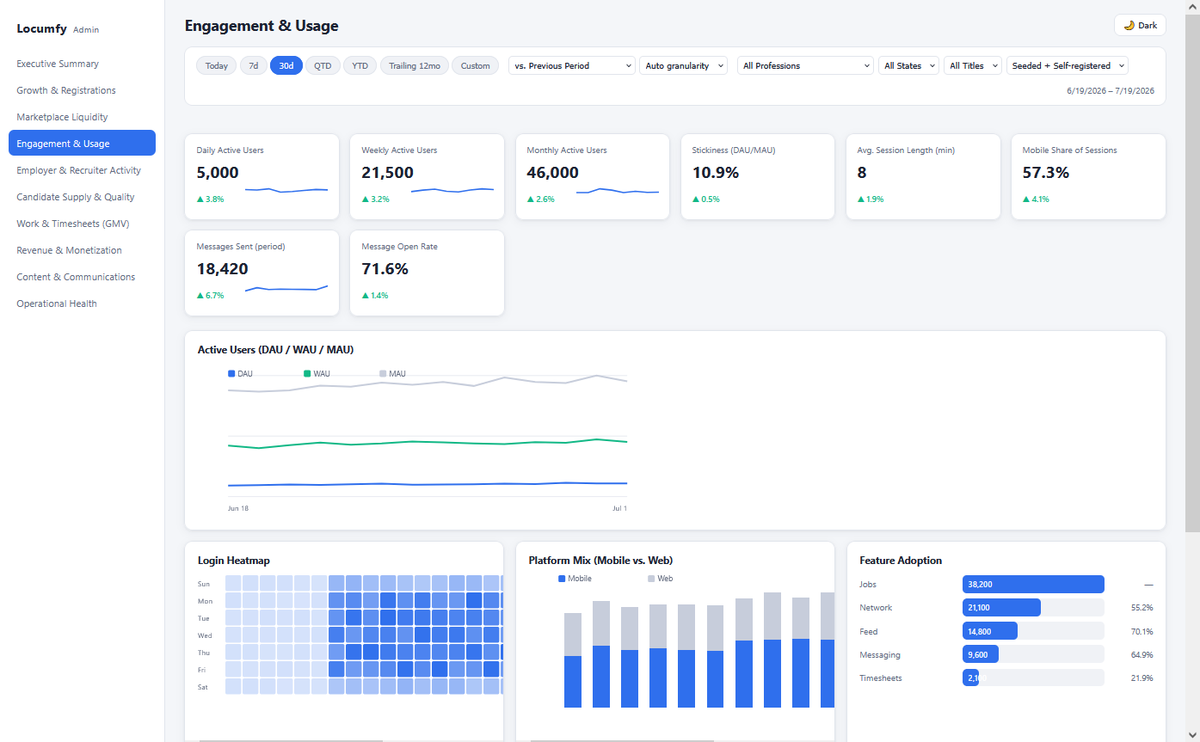
Because every profile, application, message and timesheet is structured data, the state of the platform can be read directly rather than reconstructed. The operations dashboard covers growth and registrations, marketplace liquidity, engagement and usage, recruiter activity, candidate supply and quality, hours worked, content and communications, and operational health — each filterable by profession, state, title and period.

admin.locumfy.com/engagement
The operations dashboard showing daily, weekly and monthly active users, session length, platform mix and feature adoption.